
Silicon (Si) is an important crystalline optical material widely used for infrared optical applications. Unlike visible optical glasses, silicon is not transparent in the visible wavelength range, but it provides useful transmission in the infrared region. Because of this characteristic, silicon is commonly selected for IR windows, lenses, filters, laser mirrors, biomedical imaging systems, military optics, and mid-infrared optical instruments.
Silicon is especially useful in the wavelength range from approximately 1.2 µm to 8.0 µm. This makes it suitable for near-infrared and mid-infrared applications, particularly where lightweight design, good thermal conductivity, and stable infrared performance are required.
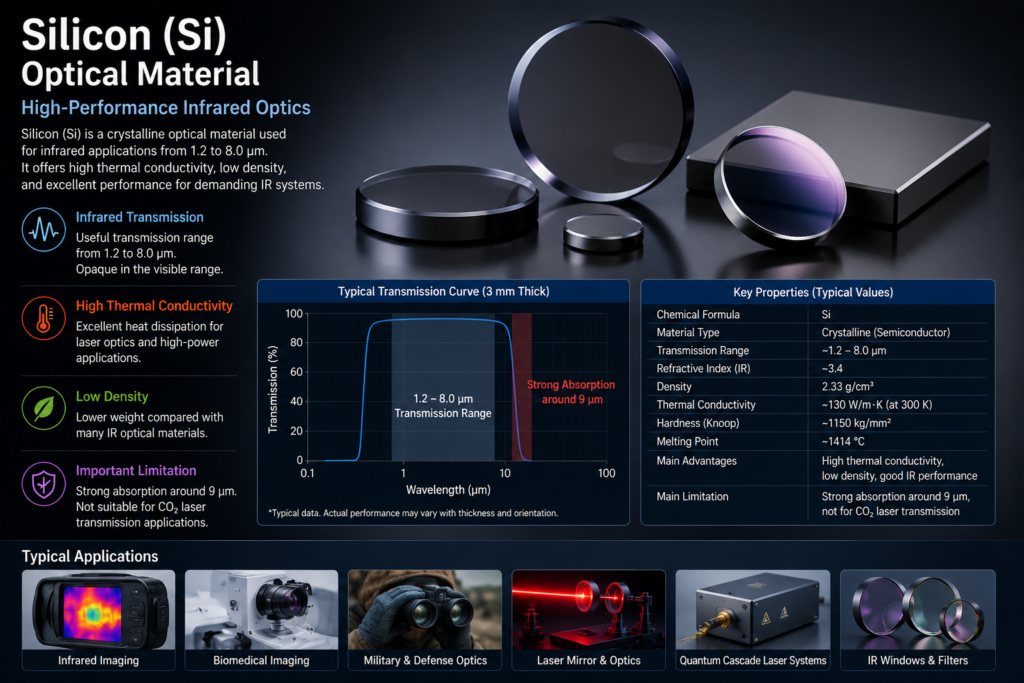
Key Properties of Silicon (Si)
| Property | Description |
|---|---|
| Material | Silicon |
| Chemical Symbol | Si |
| Material Type | Crystalline semiconductor / infrared optical material |
| Representative Transmission Range | Approx. 1.2–8.0 µm |
| Visible Transparency | Opaque in the visible range |
| Main Spectral Region | NIR and MWIR |
| Refractive Index | High, approximately 3.4 in the IR region |
| Thermal Characteristic | High thermal conductivity |
| Density | Relatively low compared with many IR materials |
| Important Limitation | Strong absorption around 9 µm |
| CO₂ Laser Transmission | Not suitable for CO₂ laser transmission applications |
| Typical Components | IR windows, lenses, filters, mirrors, substrates |
| Typical Applications | IR imaging, biomedical optics, military optics, laser mirrors, QCL-related optics |
Infrared Transmission Characteristics
Silicon is primarily used as an infrared optical material. Its useful optical transmission range begins around 1.2 µm and extends to approximately 8.0 µm. This range makes silicon suitable for near-infrared and mid-infrared optical systems.
Because silicon does not transmit visible light, it is not suitable when visual alignment through the optic is required. However, for systems operating only in the infrared region, this visible opacity is usually not a major limitation.
Typical silicon optical applications include:
▪️IR windows
▪️IR lenses
▪️Infrared filters
▪️Mid-IR optical components
▪️Laser mirrors
▪️Thermal and military imaging systems
▪️Biomedical infrared imaging
▪️Quantum cascade laser optical systems
High Refractive Index
One of the main optical features of silicon is its high refractive index. In the infrared region, silicon has a refractive index of approximately 3.4. This is much higher than many common optical glasses and fluoride materials.
A high refractive index allows optical designers to achieve strong optical power with thinner or more compact lens elements. This can be useful in compact infrared lens assemblies and systems where space and weight are important.
However, a high refractive index also means that uncoated silicon surfaces can produce significant reflection losses. For this reason, anti-reflection coatings are often required to improve transmission and reduce surface reflection.
Thermal Conductivity and Low Density
Silicon offers high thermal conductivity and relatively low density. These characteristics make it attractive for laser mirrors and infrared optical systems where thermal stability and lightweight design are important.
High thermal conductivity helps distribute heat more effectively across the optical component. This can be useful in laser-related applications or systems where the optic may experience localized heating.
Compared with heavier infrared materials such as germanium, silicon can be a practical choice when lower weight is required.
Important Limitation: Absorption Around 9 µm
A critical limitation of silicon is its strong absorption band around 9 µm. Because of this absorption, silicon is not suitable for CO₂ laser transmission applications.
This point is very important in optical material selection. CO₂ lasers commonly operate around 10.6 µm, and optical materials used for CO₂ laser transmission must be transparent at that wavelength. Silicon should not be selected as a transmitting window or lens for CO₂ laser systems.
However, silicon may still be used in certain laser mirror or substrate applications depending on the design, coating, and wavelength.
Silicon vs Germanium
Silicon and germanium are both important infrared optical materials, but they are used differently.
| Item | Silicon (Si) | Germanium (Ge) |
|---|---|---|
| Main Transmission Range | Approx. 1.2–8.0 µm | Approx. 2–16 µm |
| Visible Transparency | Opaque | Opaque |
| Refractive Index | High, around 3.4 | Very high, around 4.0 in LWIR |
| Density | Lower | Higher |
| Thermal Conductivity | High | Good, but temperature-sensitive transmission |
| LWIR Use | Limited | Strong LWIR usefulness |
| CO₂ Laser Transmission | Not suitable | Can be used depending on design/coating |
| Main Strength | Lightweight IR optics, MWIR, laser mirrors | LWIR optics, thermal imaging, high-index IR lenses |
Silicon is often preferred when lower weight, high thermal conductivity, and 1.2–8.0 µm transmission are required. Germanium is often selected when longer-wavelength infrared transmission, especially LWIR performance, is required.
Typical Applications of Silicon Optics
1. Infrared Imaging
Silicon can be used in infrared imaging systems operating within its transmission range. Its high refractive index and low density make it useful for compact IR optical designs.
2. Biomedical Imaging
Silicon optics are suitable for selected biomedical optical systems that use near-infrared or mid-infrared wavelengths. These systems may require IR windows, filters, or lens elements.
3. Military and Defense Optics
Silicon is used in military and defense-related infrared optical systems where compactness, thermal performance, and infrared transmission are important.
4. Laser Mirrors and Substrates
Because of its high thermal conductivity and low density, silicon can be used as a substrate for laser mirrors. It is especially useful when the optic must manage heat efficiently.
5. Quantum Cascade Laser Systems
Silicon optics may be used with quantum cascade laser systems depending on the output wavelength. Since QCLs are available at many mid-infrared wavelengths, silicon can be considered when the wavelength falls within its useful transmission range.
Coating Considerations
Anti-reflection coatings are usually important for silicon optics because of silicon’s high refractive index. Without coating, reflection losses at each surface can be significant.
Common coating targets include:
▪️1.2–3 µm NIR/MWIR band
▪️2–5 µm mid-IR band
▪️3–5 µm MWIR band
▪️Specific quantum cascade laser wavelengths
▪️Laser mirror coatings
▪️IR filter coatings
The coating should be selected based on wavelength, angle of incidence, polarization, laser power, and environmental durability requirements.
Design and Handling Considerations
When specifying silicon optical components, the following points should be reviewed:
▪️Operating wavelength range
▪️Whether visible transparency is required
▪️Transmission requirement
▪️Coating design
▪️Angle of incidence
▪️Laser power or heat load
▪️Thermal management
▪️Surface quality
▪️Mounting stress
▪️Environmental exposure
▪️Whether the system operates near 9 µm
The 9 µm absorption limitation should always be checked before selecting silicon for any mid-IR or long-wave IR system.
Conclusion
Silicon (Si) is a valuable infrared optical material for applications from approximately 1.2 µm to 8.0 µm. Its high refractive index, high thermal conductivity, low density, and infrared transmission make it useful for IR windows, lenses, filters, laser mirrors, biomedical imaging, military optics, and quantum cascade laser systems.
However, silicon is not transparent in the visible range and has a strong absorption band around 9 µm. Therefore, it should not be used for CO₂ laser transmission applications. When selected within its proper wavelength range, silicon is a practical and high-performance material for many infrared optical systems.