
Optical coating is one of the most important factors in custom optical component performance. Even if the substrate material and mechanical dimensions are correct, the final optical performance may not meet the system requirement if the coating specification is not properly defined.
Optical coatings are used to control transmission, reflection, absorption, durability, and spectral performance. They are widely applied to lenses, windows, mirrors, filters, prisms, and other precision optical components.
For custom optics, coating requirements should be defined clearly at the beginning of the project. This helps reduce design risk, avoid communication errors, and improve the reliability of the final optical system.
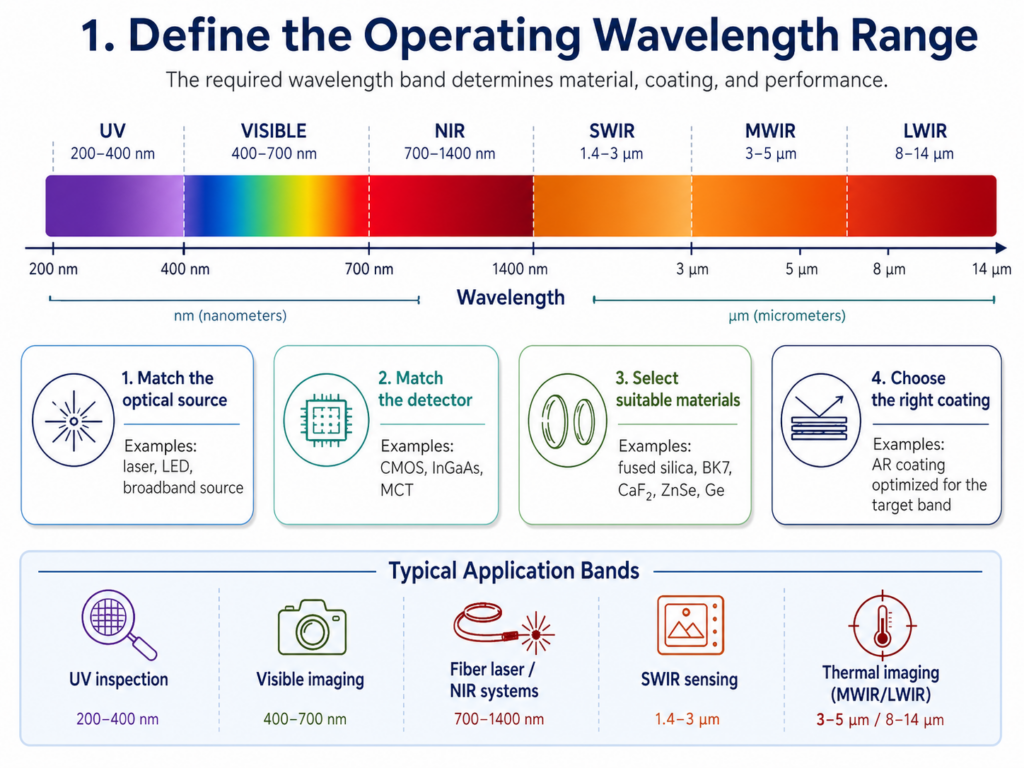
1. Define the Operating Wavelength Range
The first step is to define the wavelength range.
Optical coating performance is highly dependent on wavelength. A coating designed for visible light may not work properly in UV, SWIR, MWIR, or LWIR applications.
Common wavelength ranges include:
- UV
- Visible
- NIR
- SWIR
- MWIR
- LWIR
- CO2 laser wavelength
- Broadband optical systems
For example, a coating for a visible imaging lens may focus on high transmission from 400 nm to 700 nm. In contrast, an infrared window may require high transmission in the 3–5 µm or 8–12 µm range. A CO2 laser optic may require coating performance around 10.6 µm.
The required wavelength range should be specified as clearly as possible.
2. Decide the Coating Function
Different optical systems require different coating functions.
Common coating types include:
- Anti-reflection coating
- High-reflection coating
- Bandpass filter coating
- Longpass filter coating
- Shortpass filter coating
- Neutral density coating
- Polarizing coating
- DLC coating
- Metal coating
- Infrared coating
- UV coating
An anti-reflection coating is used to reduce surface reflection and improve transmission. A high-reflection coating is used for mirrors and laser systems. Filter coatings are used to selectively transmit or block specific wavelength ranges.
Before requesting a coating, it is important to define the main optical function clearly.
For example:
- Should the component transmit light?
- Should it reflect light?
- Should it block unwanted wavelengths?
- Should it work as a filter?
- Should it improve durability?
- Should it withstand high laser power?
A clear coating purpose leads to a better coating design.
3. Specify Transmission or Reflection Targets
After defining the coating function, the required optical performance should be expressed numerically whenever possible.
Useful coating specifications include:
- Transmission percentage
- Reflection percentage
- Blocking range
- Optical density
- Average transmission
- Peak transmission
- Reflectance at design wavelength
- Spectral curve requirement
For example, instead of saying “high transmission coating,” it is better to state:
“Average transmission greater than 95% from 400 nm to 700 nm.”
For a mirror coating, instead of saying “high reflection,” it is better to state:
“Reflectance greater than 99% at 1064 nm.”
Specific numerical targets help the coating supplier design, manufacture, and inspect the coating more accurately.
4. Confirm the Angle of Incidence
The angle of incidence is another important coating parameter.
Optical coating performance changes depending on the angle at which light hits the surface. A coating designed for normal incidence may show different transmission or reflection when used at 30 degrees or 45 degrees.
Important angle-related information includes:
- Normal incidence
- 45-degree incidence
- Wide-angle operation
- Beam cone angle
- System alignment tolerance
For filters and mirrors, angle of incidence can significantly shift the spectral response. This is especially important for bandpass filters, dichroic mirrors, and laser optics.
If the optical component will be used at a specific angle, this information should always be included in the coating requirement.
5. Consider Polarization
Polarization can also affect coating performance.
In some optical systems, the difference between S-polarization and P-polarization becomes important. This is especially true for laser optics, beam splitters, polarizers, and components used at non-normal incidence.
When needed, coating requirements should specify:
- Unpolarized light
- S-polarization
- P-polarization
- Polarization ratio
- Polarization-dependent loss
If polarization is not considered, the actual system performance may differ from the expected coating performance.
6. Review Laser Power and Damage Threshold
For laser applications, coating durability is critical.
High-power laser systems may require coating designs with high laser damage threshold. If the coating cannot withstand the laser power or energy density, the optical component may degrade or fail during operation.
Important laser-related information includes:
- Laser wavelength
- Continuous wave or pulsed laser
- Average power
- Pulse energy
- Pulse duration
- Repetition rate
- Beam diameter
- Energy density
- Required LIDT level
LIDT, or laser-induced damage threshold, should be considered early when the optic will be used in laser systems.
A coating for low-power alignment optics and a coating for high-power laser optics may require very different design and process conditions.
7. Check Environmental Conditions
Optical coatings are not used only in clean laboratory environments. Many optical components are used in industrial, outdoor, defense, aerospace, biomedical, and high-temperature environments.
Environmental factors may include:
- Temperature
- Humidity
- Salt spray
- Dust
- Abrasion
- Cleaning process
- Chemical exposure
- Vacuum condition
- Thermal cycling
- Outdoor use
For harsh environments, coating durability can be as important as optical performance.
In some cases, additional durability requirements should be discussed, such as adhesion, abrasion resistance, humidity resistance, and salt-spray resistance.
DLC coating may be considered for applications requiring improved durability, scratch resistance, and environmental stability.
8. Match Coating with Substrate Material
The coating must be compatible with the substrate material.
Different materials have different thermal, mechanical, and surface characteristics. These differences affect coating adhesion, stress, durability, and spectral performance.
Common substrate materials include:
- BK7
- Fused silica
- Sapphire
- Silicon
- Germanium
- ZnSe
- CaF2
- MgF2
- Optical glass
For example, infrared materials such as germanium, silicon, and zinc selenide require coating designs suitable for IR transmission and material properties. UV materials such as fused silica and calcium fluoride may require coatings optimized for short wavelengths and UV durability.
The substrate and coating should be reviewed together, not separately.
9. Request Spectral Measurement Data
For custom optical coatings, measurement data is important.
A coating supplier should provide inspection data when required, especially for precision, laser, IR, and high-reliability applications.
Useful data may include:
- Transmission curve
- Reflection curve
- Blocking curve
- Coating uniformity data
- LIDT test report
- Environmental test report
- Inspection report
- Certificate of conformity
Spectral measurement data helps confirm that the coating meets the required wavelength and performance specification.
For B2B and OEM customers, this documentation is also useful for internal quality review and system validation.
10. Prepare Clear Coating Information for RFQ
To receive an accurate quotation, the coating requirement should be prepared clearly.
A good RFQ for optical coating should include:
- Substrate material
- Component type
- Diameter and thickness
- Coating type
- Operating wavelength range
- Required transmission or reflection
- Angle of incidence
- Polarization condition
- Laser power or energy density
- Environmental requirement
- Quantity
- Required test data
- Target delivery schedule
If the full specification is not fixed yet, it is still useful to provide the application and wavelength first. The coating supplier can then suggest possible coating options.
Conclusion
Defining optical coating requirements is essential for successful custom optics development. The coating specification should include wavelength range, coating function, transmission or reflection target, angle of incidence, polarization, substrate material, laser power, and environmental conditions.
A well-defined coating requirement helps improve optical performance, reduce development risk, and ensure stable operation in the final system.
General Optics supports custom optical coatings for UV, visible, infrared, laser, imaging, and industrial applications. Our capabilities include optical fabrication, AR/HR/filter/polarizer/DLC coating, inspection, and application-based technical review.
Need help defining optical coating requirements? Contact General Optics to discuss your custom optical coating project. https://www.generaloptics.kr/contact