
Magnesium Fluoride (MgF₂) is a crystalline optical material widely used for ultraviolet, visible, near-infrared, and infrared optical applications. It is especially valued for its excellent transmission in the deep ultraviolet region, broad usability from UV to IR, and strong mechanical durability compared with many other optical materials that transmit in similar wavelength ranges.
Because MgF₂ combines UV transmission, infrared usability, low refractive index, and high environmental durability, it is commonly used for optical windows, lenses, prisms, laser optics, machine vision systems, microscopy, spectroscopy, and industrial optical instruments.
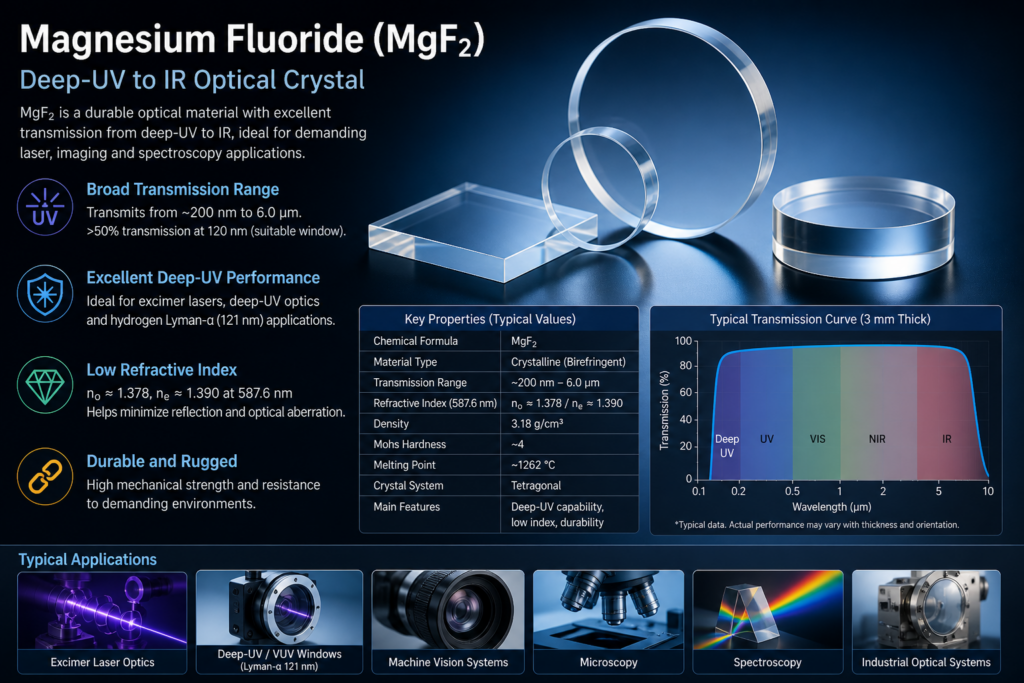
Key Properties of Magnesium Fluoride (MgF₂)
| Property | Description |
|---|---|
| Material | Magnesium Fluoride |
| Chemical Formula | MgF₂ |
| Material Type | Crystalline optical material |
| Representative Transmission Range | Approx. 200 nm – 6.0 µm |
| Deep-UV / VUV Performance | More than 50% transmission at 120 nm in suitable window form |
| Spectral Coverage | Deep UV, UV, visible, NIR, and IR |
| Refractive Index | Ordinary n ≈ 1.378 / extraordinary n ≈ 1.390 at 587.6 nm |
| Optical Characteristic | Birefringent crystal |
| Main Advantages | Broad transmission, durability, low refractive index, minimal aberration |
| Mechanical Characteristic | Rugged and durable for demanding environments |
| Typical Components | Windows, lenses, prisms, protective optics |
| Typical Applications | Excimer lasers, deep-UV optics, machine vision, microscopy, spectroscopy, industrial optics |
Broad Transmission from Deep UV to Infrared
One of the most important advantages of Magnesium Fluoride is its broad optical transmission range. MgF₂ is suitable for applications from the ultraviolet region to the infrared region, typically from approximately 200 nm to 6.0 µm.
This broad transmission makes MgF₂ useful when one optical material must support several wavelength regions. It can be applied in UV optical systems, visible inspection instruments, near-infrared systems, and selected infrared optical assemblies.
In particular, MgF₂ is highly valuable for deep-UV applications. In suitable MgF₂ window form, it can provide more than 50% transmission at 120 nm, making it useful for vacuum ultraviolet applications, excimer laser systems, and hydrogen Lyman-α applications near 121 nm.
Excellent Deep-UV Performance
Magnesium Fluoride is one of the important optical materials for deep ultraviolet and vacuum ultraviolet systems. Many common optical glasses lose transmission in the deep-UV range, but MgF₂ can continue to transmit at very short wavelengths.
This makes MgF₂ suitable for:
• Excimer laser optics
• Deep-UV optical windows
• Vacuum-UV optical systems
• Hydrogen Lyman-α line applications
• UV spectroscopy
• UV detectors and emitters
• Scientific and industrial UV instruments
For optical systems operating below 200 nm, material choice becomes very limited. MgF₂ is therefore an important substrate when short-wavelength UV transmission is required.
Low Refractive Index
MgF₂ has a relatively low refractive index compared with many other optical materials. At 587.6 nm, the ordinary refractive index is approximately 1.378, while the extraordinary refractive index is approximately 1.390.
This low refractive index helps reduce surface reflection compared with high-index infrared materials. It is one reason MgF₂ is also well known as a coating material for anti-reflection applications.
For optical components such as windows and lenses, a lower refractive index can help improve transmission and reduce reflection losses, especially when paired with proper coating design.
Birefringence and Crystal Orientation
Magnesium Fluoride is a birefringent crystal. This means that its refractive index depends on the polarization direction and crystal axis. In practical optical design, this property must be considered carefully.
For window applications, MgF₂ components are often cut with a controlled crystal orientation to minimize birefringence effects in the transmitted beam. This is especially important for precision optical systems, laser systems, and polarization-sensitive instruments.
If the application is polarization-sensitive, the optical designer should specify the required crystal orientation, beam direction, angle of incidence, and polarization condition before selecting the final MgF₂ component.
Durability and Environmental Stability
Another major advantage of Magnesium Fluoride is its durability. MgF₂ is rugged compared with many optical materials that provide deep-UV or infrared transmission. It is suitable for high-stress environments and industrial applications where the optic may be exposed to mechanical or thermal stress.
MgF₂ windows are often selected when the system requires:
• High durability
• Good UV transmission
• Resistance to demanding environments
• Low optical aberration
• Stable performance in industrial systems
• Long-term reliability
This makes MgF₂ useful not only in laboratory instruments but also in machine vision, microscopy, and industrial optical equipment.
Magnesium Fluoride for Laser Applications
MgF₂ is suitable for laser-related optical systems, especially when the operating wavelength is in the deep-UV or UV range. Excimer laser systems are one of the key application areas.
Excimer lasers can operate at short UV wavelengths and require optical materials that can transmit UV light while withstanding demanding optical conditions. MgF₂ is useful in this area because it provides deep-UV transmission and good durability.
Typical laser-related MgF₂ components include:
• Laser windows
• Protective windows
• Beam sampling windows
• UV lenses
• Vacuum-UV windows
• Excimer laser optical components
For laser use, coating design, surface quality, damage threshold, and cleaning procedure should be reviewed carefully.
Comparison with Calcium Fluoride
Magnesium Fluoride and Calcium Fluoride are both important fluoride optical crystals. However, they are not identical and should be selected according to the wavelength range and operating environment.
| Item | Magnesium Fluoride (MgF₂) | Calcium Fluoride (CaF₂) |
|---|---|---|
| Typical Transmission Range | Approx. 200 nm – 6.0 µm | Approx. 180 nm – 8.0 µm |
| Deep-UV / VUV Use | Very strong deep-UV capability | Excellent UV-to-IR coverage |
| Refractive Index | Lower, around 1.38 range | Around 1.43 range at 1.064 µm |
| Crystal Property | Birefringent | Isotropic cubic crystal |
| Main Strength | Deep-UV durability and low refractive index | Broad UV-to-IR transmission and low dispersion |
| Typical Applications | Excimer lasers, VUV, UV windows, machine vision | UV optics, spectroscopy, IR windows, thermal imaging |
MgF₂ is often selected when deep-UV transmission, ruggedness, and low refractive index are priorities. CaF₂ may be preferred when broader UV-to-IR transmission and low dispersion are more important.
Typical Applications of MgF₂ Optics
1. Excimer Laser Optics
MgF₂ is well suited for excimer laser systems because of its deep-UV transmission and durability. It can be used for windows, lenses, and protective optical components in UV laser systems.
2. Deep-UV and Vacuum-UV Windows
Because MgF₂ can transmit into very short UV wavelengths, it is useful for deep-UV and vacuum-UV windows. This includes applications involving the hydrogen Lyman-α line near 121 nm.
3. Machine Vision Systems
MgF₂ is durable and optically stable, making it useful in machine vision systems where reliable optical windows or protective optics are required.
4. Microscopy
MgF₂ can be used in microscopy systems, especially when UV transmission or broad spectral performance is required.
5. Spectroscopy
MgF₂ is suitable for UV and broadband spectroscopy because of its wide transmission range and low absorption in the UV region.
6. Industrial Optical Systems
Because of its rugged nature, MgF₂ is useful for industrial optical systems where durability and stable optical performance are required.
Design and Handling Considerations
When using Magnesium Fluoride in an optical system, the following points should be reviewed:
• Operating wavelength range
• Deep-UV or VUV transmission requirement
• Crystal orientation
• Polarization sensitivity
• Surface quality
• Coating requirement
• Laser power or energy density
• Operating temperature
• Mechanical mounting condition
• Cleaning and handling method
• Environmental exposure
Because MgF₂ is birefringent, crystal orientation should not be ignored in precision applications. For simple protective windows, birefringence may not be critical, but for laser, imaging, or polarization-sensitive systems, orientation can affect optical performance.
Coating Considerations
MgF₂ is widely known as a low-index optical coating material, but MgF₂ substrates themselves may also be coated depending on the application.
Anti-reflection coatings may be used to improve transmission at specific wavelength bands, such as:
• Deep UV
• UV-visible
• Visible-NIR
• 1–6 µm infrared range
• Specific laser wavelengths
For UV and excimer laser applications, coating durability and laser damage resistance are especially important. The coating must be designed not only for high transmission but also for long-term stability under UV exposure.
Conclusion
Magnesium Fluoride (MgF₂) is a highly useful optical material for deep-UV, UV, visible, near-infrared, and infrared applications. Its combination of broad transmission, excellent deep-UV performance, low refractive index, durability, and industrial usability makes it one of the most important fluoride optical materials.
It is especially valuable for excimer laser optics, vacuum-UV windows, UV spectroscopy, machine vision, microscopy, and industrial optical systems. While MgF₂ offers strong performance, designers should consider its birefringence, crystal orientation, coating requirements, and operating environment when specifying MgF₂ optical components.