
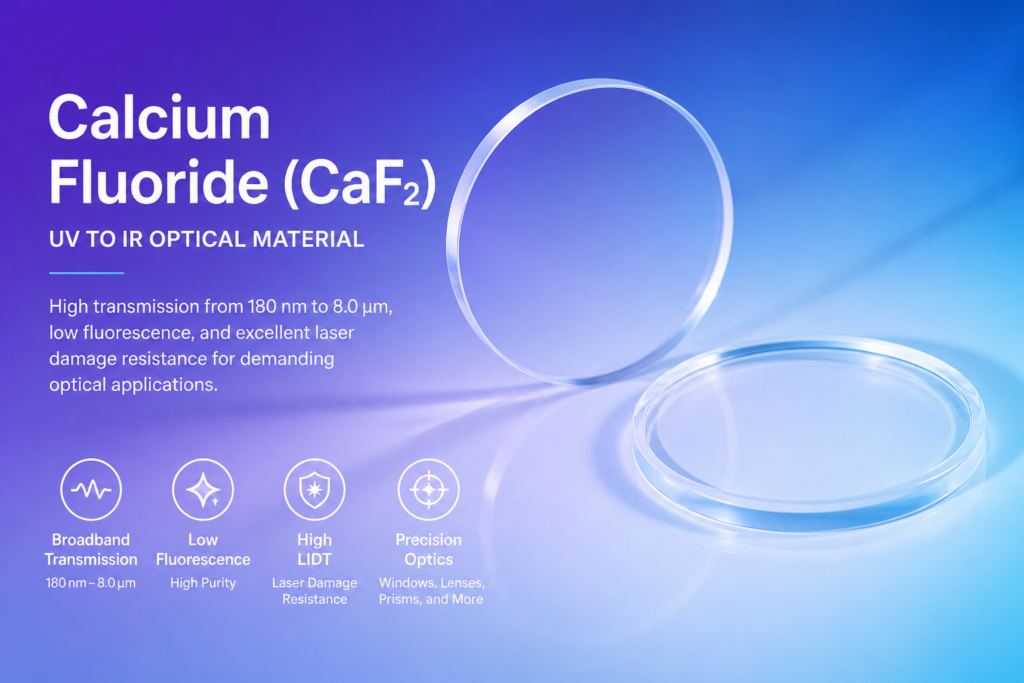
Calcium Fluoride (CaF₂) is a high-performance optical material widely used in ultraviolet, visible, and infrared optical systems. It offers excellent transmission from the deep ultraviolet region to the mid-infrared range, making it suitable for UV optics, spectroscopy, excimer laser systems, infrared windows, and precision optical components.
With its low refractive index, low fluorescence, high optical homogeneity, and good laser damage resistance, CaF₂ is often selected for demanding optical applications where stable transmission and material reliability are required.
Key Features of Calcium Fluoride (CaF₂)
Optical Properties
| Property | Value |
|---|---|
| Transmission Range | 0.13 to 10 µm |
| Refractive Index | 1.39908 at 5 µm |
| Reflection Loss | 5.4% at 5 µm |
| Absorption Coefficient | 7.8 × 10⁻⁴ cm⁻¹ at 2.7 µm |
| Reststrahlen Peak | 35 µm |
| dn/dT | -10.6 × 10⁻⁶ /°C |
| dn/dµ = 0 | 1.7 µm |
Thermal Properties
| Property | Value |
|---|---|
| Melting Point | 1360°C |
| Thermal Conductivity | 9.71 W·m⁻¹·K⁻¹ |
| Thermal Expansion | 18.85 × 10⁻⁶ /°C |
| Specific Heat Capacity | 854 J·kg⁻¹·K⁻¹ |
Mechanical Properties
| Property | Value |
|---|---|
| Density | 3.18 g/cc |
| Hardness | Knoop 158.3, 100 g with 500 g indenter |
| Young’s Modulus (E) | 75.8 GPa |
| Shear Modulus (G) | 33.77 GPa |
| Bulk Modulus (K) | 82.71 GPa |
| Elastic Coefficients | C11 = 164, C12 = 53, C44 = 33.7 |
| Apparent Elastic Limit | 36.54 MPa |
| Poisson Ratio | 0.26 |
Chemical and Structural Properties
| Property | Value |
|---|---|
| Dielectric Constant | 6.76 at 1 MHz |
| Solubility | 0.0017 g / 100 g water at 20°C |
| Molecular Weight | 78.08 |
| Class / Structure | Cubic, (111) cleavag |
Advantages of CaF₂ Optical Material
Calcium Fluoride provides excellent optical transmission over a broad wavelength range. Unlike many standard optical glasses, CaF₂ can be used in the ultraviolet region down to approximately 180 nm, while also maintaining useful transmission into the infrared region up to about 8.0 µm.
Its low refractive index helps reduce surface reflection losses, and anti-reflection coating can further improve transmission at specific wavelengths or across a defined broadband range. CaF₂ also exhibits low fluorescence, making it especially useful for spectroscopy, laser systems, and high-sensitivity optical measurements.
Typical Applications
UV Optical Systems
CaF₂ is commonly used for UV lenses, UV windows, prisms, and excimer laser optics. Its transmission in the ultraviolet region makes it suitable for applications where conventional glass materials are not adequate.
Infrared Windows and Lenses
Because CaF₂ transmits into the infrared range, it can be used for IR windows, IR lenses, thermal imaging optics, and sensor protection windows. It is often considered when both UV and IR performance are required from a single material.
Spectroscopy and Analytical Instruments
Low fluorescence and high optical homogeneity make CaF₂ suitable for spectroscopy, FTIR systems, gas analysis, bio-chemical analysis, and other precision measurement instruments.
Laser Optics
CaF₂ is suitable for laser optical components where low absorption, high transmission, and stable material performance are required. It is frequently used in excimer laser systems and other UV laser applications.
Calcium Fluoride vs Barium Fluoride
| Item | Calcium Fluoride (CaF₂) | Barium Fluoride (BaF₂) |
|---|---|---|
| Transmission Range | 180 nm – 8.0 µm | Approx. 150 nm – 14 µm |
| Main Strength | UV stability and low fluorescence | Wider infrared transmission |
| Mechanical Property | Relatively harder | Softer and more delicate |
| Typical Use | UV optics, spectroscopy, laser optics | IR spectroscopy, thermal imaging, LWIR optics |
| Material Selection Point | Better for UV and precision optics | Better for longer IR wavelength applications |
CaF₂ is generally preferred when ultraviolet transmission, low fluorescence, and material stability are important. BaF₂ is more suitable when longer infrared wavelength transmission is required. The final material selection should be based on wavelength range, environmental conditions, mechanical requirements, coating design, and cost.
Custom CaF₂ Optical Components from General Optics
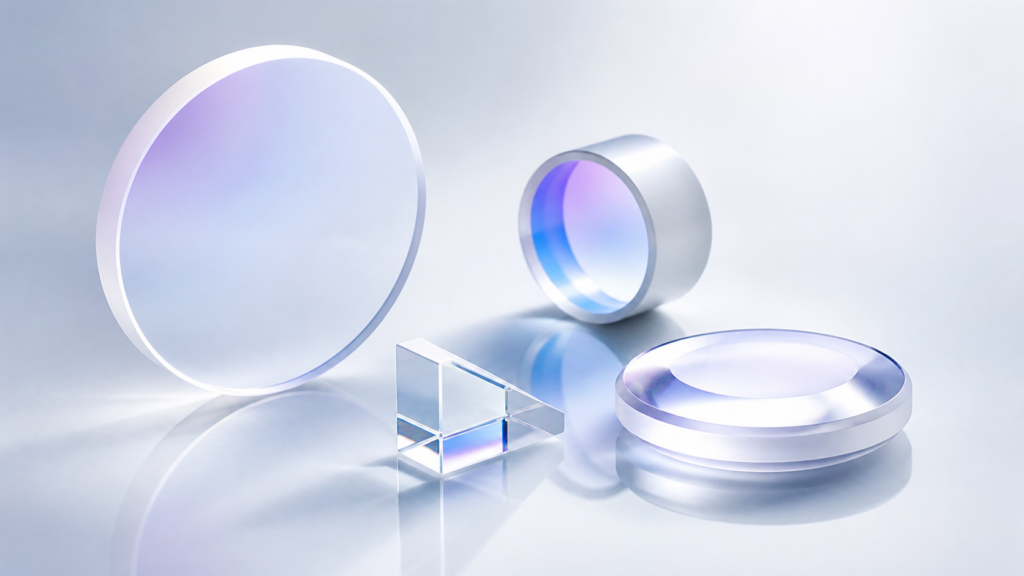
General Optics provides custom optical components based on customer drawings and specifications. CaF₂ optical components can be manufactured for UV, visible, and infrared applications.
| Product Type | Typical Application |
|---|---|
| CaF₂ Windows | UV windows, IR protection windows, spectroscopy windows |
| CaF₂ Lenses | UV lenses, IR lenses, analytical instrument optics |
| CaF₂ Prisms | Beam control, dispersion, spectroscopy |
| Coated CaF₂ Optics | AR-coated windows, lenses, and custom optics |
| Custom CaF₂ Components | OEM optics, special shapes, large-diameter components |
General Optics supports precision optical fabrication, polishing, coating, inspection, and assembly processes. For CaF₂ optics, coating design and surface quality are especially important because the final optical performance depends not only on the material itself but also on the surface finish, coating durability, and dimensional accuracy.
Design Considerations for CaF₂ Optics
When designing CaF₂ optical components, the following factors should be reviewed carefully:
| Design Factor | Consideration |
|---|---|
| Operating Wavelength | UV, visible, IR, or broadband use |
| Transmission Requirement | Target transmission and allowable loss |
| Coating Type | Uncoated, single-wavelength AR, broadband AR |
| Surface Quality | Scratch-dig, surface roughness, flatness |
| Dimensional Tolerance | Diameter, thickness, parallelism, radius of curvature |
| Environment | Temperature, humidity, vacuum, laser power |
| Inspection | Transmission, surface quality, coating performance, dimensional accuracy |
For UV and laser applications, surface cleanliness, coating quality, and laser damage resistance should be considered from the early design stage.
Conclusion
Calcium Fluoride (CaF₂) is an excellent optical material for applications requiring broad transmission from the ultraviolet to the infrared region. Its low refractive index, low fluorescence, high optical homogeneity, and stable optical performance make it suitable for UV optics, spectroscopy, laser systems, infrared windows, and precision optical components.
General Optics provides custom CaF₂ windows, lenses, prisms, and coated optical components according to customer requirements. Please contact us for custom specifications, coating options, drawings, and technical consultation.