
Germanium (Ge) is one of the most widely used optical materials for infrared applications. Unlike many optical glasses that are designed for visible or near-infrared wavelengths, germanium is opaque in the visible region but highly useful in the infrared region. Because of this unique optical behavior, germanium is commonly used for IR windows, lenses, thermal imaging optics, IR laser systems, and infrared measurement instruments.
One of the most important characteristics of germanium is its broad infrared transmission range. Germanium typically transmits in the wavelength range of approximately 2 µm to 16 µm, making it suitable for mid-wave infrared (MWIR) and long-wave infrared (LWIR) optical systems. This range includes two important atmospheric transmission bands: 3–5 µm and 8–12 µm. These wavelength regions are widely used in thermal imaging, night vision, surveillance, biomedical imaging, military imaging, and infrared sensing.
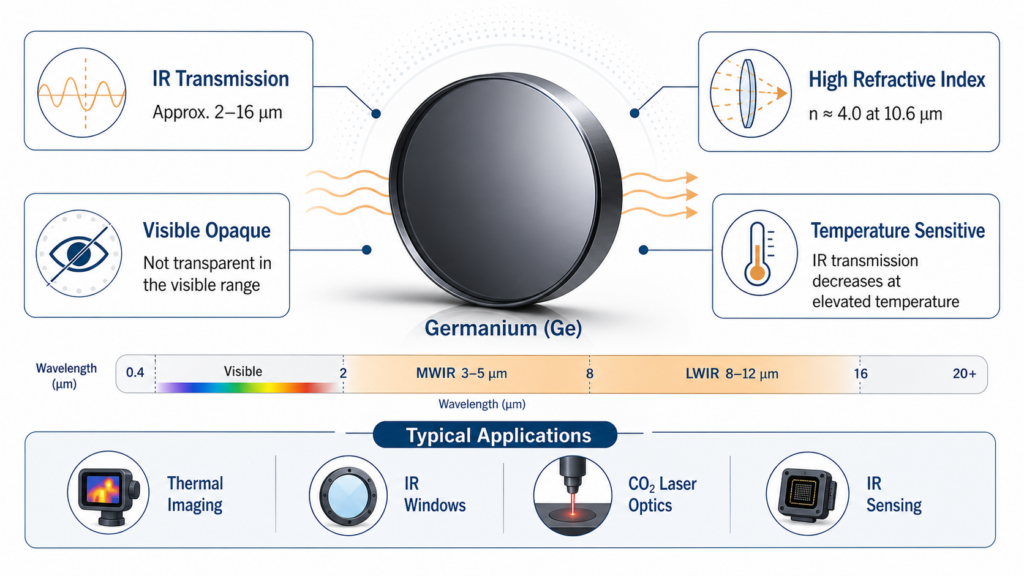
| Property | Description |
|---|---|
| Material | Germanium |
| Chemical Symbol | Ge |
| Material Type | Crystalline infrared optical material |
| Representative Transmission Range | Approx. 2–16 µm |
| Visible Transparency | Opaque in the visible region |
| Main Spectral Region | MWIR and LWIR |
| Refractive Index | Approx. 4.004 at 10.6 µm |
| Chemical Resistance | Inert to air, water, alkalis, and most acids, except nitric acid |
| Temperature Sensitivity | Transmission decreases significantly at elevated temperatures |
| Typical Components | IR windows, lenses, filters, prisms, thermal imaging optics |
| Typical Applications | IR laser systems, thermal imaging, biomedical imaging, military imaging, IR sensing |
Why Germanium Is Important for Infrared Optics
Germanium is highly valued in infrared optics because it combines strong infrared transmission with a very high refractive index. A high refractive index allows optical designers to achieve strong optical power with relatively compact lens shapes. This makes germanium especially useful for compact infrared lens assemblies and thermal imaging systems.
In many LWIR systems, germanium lenses are used because they can efficiently transmit thermal radiation emitted by objects. Since thermal imaging cameras detect infrared radiation rather than visible light, germanium is a practical and effective material for these systems.
Germanium is also commonly used in IR laser optics. In particular, it is relevant for systems operating around 10.6 µm, such as CO₂ laser applications. At this wavelength, germanium has a refractive index of approximately 4.004, which is much higher than many other optical materials.
Infrared Transmission Characteristics
Germanium’s useful transmission range is approximately 2–16 µm. This makes it suitable for optical systems operating in the mid-infrared and long-wave infrared regions. However, it should be noted that germanium does not transmit visible light. This means visual alignment through the optic is not possible in the same way as with materials such as zinc selenide or some fluoride crystals.
This visible opacity can be a limitation during system setup, but it is not necessarily a disadvantage in actual IR operation. In systems where only infrared performance is required, germanium’s visible opacity is usually acceptable.
Temperature Sensitivity
One of the most important design considerations for germanium is temperature. Germanium’s transmission is highly sensitive to temperature. As temperature increases, absorption also increases. At approximately 100 °C, germanium can become nearly opaque, and at around 200 °C, it can become essentially non-transmissive.
This means germanium is not always suitable for high-temperature optical systems unless thermal conditions are carefully controlled. In infrared systems exposed to elevated temperatures, designers must consider heat load, operating environment, coating performance, and possible thermal defocusing.
For this reason, germanium optics are often used in systems where the operating temperature is controlled or where the optical component is protected from excessive heating.
Chemical and Environmental Stability
Germanium has good chemical resistance under many conditions. It is generally inert to air, water, alkalis, and most acids. However, nitric acid is an important exception. This chemical stability makes germanium useful in many optical assemblies, provided that cleaning and handling procedures are properly controlled.
Although germanium is chemically stable in many environments, optical surfaces still require careful handling. Fingerprints, dust, scratches, and coating damage can reduce performance, especially in precision infrared systems. Gloves should always be worn when handling germanium optics.
Handling Considerations
Germanium must be handled carefully. Like other precision optical materials, it should not be touched directly with bare hands. In addition, germanium dust can be hazardous, so machining, grinding, or polishing operations require appropriate safety controls.
Finished germanium optics should be stored in clean, dry conditions and protected from abrasive contact. Since many germanium optics are coated for specific infrared wavelength bands, surface protection is important to maintain transmission and durability.
Germanium vs Other Infrared Materials
Germanium is often compared with silicon, zinc selenide, zinc sulfide, and chalcogenide glass.
| Material | Main Strength | Main Limitation |
|---|---|---|
| Germanium | High refractive index and strong LWIR usefulness | Temperature-sensitive transmission |
| Silicon | Good for 1.2–7 µm IR applications | Not suitable for full LWIR |
| Zinc Selenide | Broad IR transmission and visible alignment possible | Softer and easier to scratch |
| Zinc Sulfide | Useful for multispectral IR windows | Material grade and cost considerations |
| Chalcogenide Glass | Moldable IR optics and lighter system design | Composition-dependent durability |
| Sapphire | Mechanically strong and durable | Limited longer-wavelength IR transmission |
Germanium remains a preferred material when high refractive index, LWIR performance, and compact optical design are important. However, for high-temperature systems, visible alignment needs, or molded high-volume optics, alternative materials may be considered.
Typical Applications of Germanium Optics
Thermal Imaging Systems
Germanium is widely used in thermal imaging cameras because it transmits long-wave infrared radiation. These systems are used in industrial inspection, security, surveillance, firefighting, automotive night vision, and defense applications.
Military and Defense Imaging
Germanium optics are commonly used in military infrared systems because of their strong LWIR performance. Applications include target detection, surveillance, tracking systems, and night vision equipment.
Biomedical Imaging
Germanium can be used in certain biomedical infrared imaging systems where mid-infrared or long-wave infrared transmission is required. Its infrared performance allows detection and measurement beyond the visible region.
IR Laser Systems
Germanium is suitable for certain IR laser optics, especially where the operating wavelength falls within its transmission range. Its high refractive index and infrared transmission make it useful for specialized laser windows and lenses.
Infrared Filters and Optical Components
Germanium is also used as a substrate for IR filters and other precision components. Its optical properties make it suitable for systems that require controlled infrared transmission and blocking of visible light.
Design Considerations for Germanium Components
When selecting germanium for an optical system, several factors should be reviewed:
• Operating wavelength range
• Required transmission band
• Operating temperature
• Coating requirements
• Surface quality
• Mechanical mounting method
• Thermal expansion and thermal lensing
• Environmental exposure
• Safety and handling procedure
Germanium is not simply a general-purpose optical material. It is a specialized infrared material that performs very well under the right conditions but requires careful design when temperature, coating durability, and handling are involved.
Coating Requirements
Because germanium has a very high refractive index, uncoated germanium surfaces can produce significant reflection losses. Anti-reflection coatings are usually required to improve transmission in the target infrared wavelength band.
Common coating bands include:
• 3–5 µm MWIR
• 7–12 µm LWIR
• 8–12 µm thermal imaging band
• 10.6 µm CO₂ laser wavelength
The correct coating depends on the system’s operating wavelength, incident angle, power level, and environmental requirements.
Conclusion
Germanium is a key infrared optical material for MWIR and LWIR applications. Its broad 2–16 µm transmission range, high refractive index, and usefulness in thermal imaging and IR laser systems make it one of the most important materials in infrared optics.
However, germanium must be selected carefully because its transmission is strongly affected by temperature. It is best suited for systems where infrared performance is required and thermal conditions are properly managed.
For applications such as thermal imaging, military imaging, IR laser optics, biomedical imaging, and infrared sensing, germanium remains a highly valuable optical substrate. Its combination of high refractive index, infrared transmission, and chemical stability makes it an essential material for advanced infrared optical components.