
Chalcogenide optical materials are an important class of infrared-transmitting materials used in thermal imaging, infrared sensing, laser systems, spectroscopy, and advanced optical components. Unlike conventional oxide glasses, which are mainly optimized for visible and near-infrared wavelengths, chalcogenide materials are designed to transmit light in the infrared region, especially in the mid-wave infrared (MWIR) and long-wave infrared (LWIR) ranges.
The term “chalcogenide” refers to materials containing one or more chalcogen elements such as sulfur (S), selenium (Se), or tellurium (Te). In optical glass manufacturing, these elements are commonly combined with elements such as germanium (Ge), arsenic (As), antimony (Sb), gallium (Ga), or tin (Sn) to form infrared-transparent glasses. Because of their chemical structure and low phonon energy, chalcogenide glasses can transmit infrared light much more effectively than standard silica-based glasses.
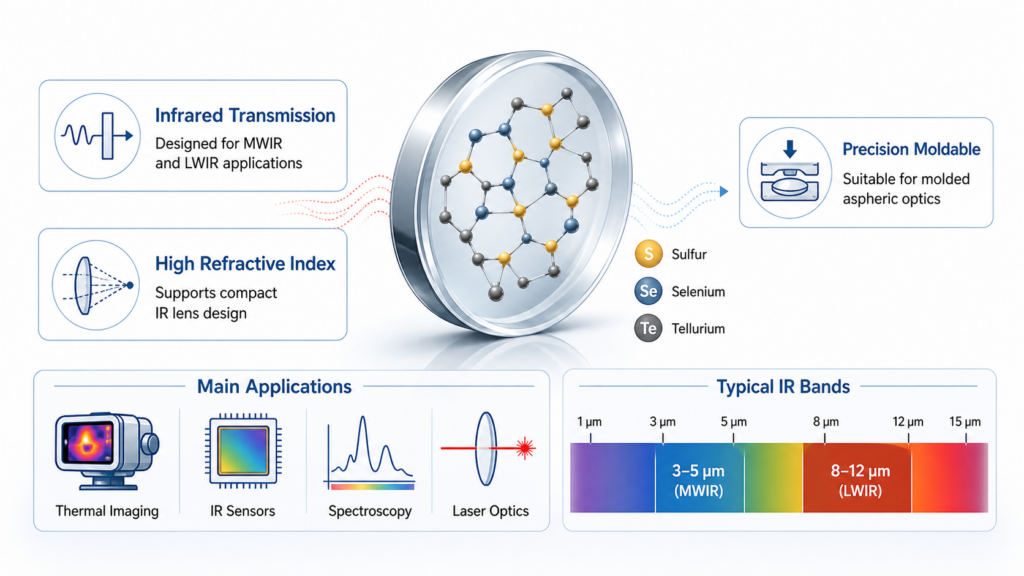
What Is Chalcogenide Glass?
Chalcogenide glass is a non-oxide glass material based on sulfur, selenium, or tellurium. Conventional optical glass is typically made from oxide-based networks such as silica, borosilicate, or phosphate glass. These materials are excellent for visible optics but have limited transmission in the mid-infrared region.
Chalcogenide glass is different. Its atomic bonding structure allows infrared radiation to pass through over a much wider wavelength range. Depending on composition, chalcogenide glasses can transmit from the near-infrared to the mid-infrared or even toward the long-wave infrared region. This makes them highly valuable for optical systems operating in the 3–5 µm and 8–12 µm atmospheric windows.
These two wavelength bands are especially important because they correspond to major infrared transmission windows in the atmosphere. Many thermal imaging cameras, gas detection systems, environmental sensors, and defense-related infrared systems are designed around these wavelength ranges.
Typical Optical Characteristics
| Property | General Description |
|---|---|
| Material Type | Infrared-transmitting non-oxide glass |
| Main Elements | S, Se, Te combined with Ge, As, Sb, Ga, or other elements |
| Main Spectral Region | Near-IR, MWIR, and LWIR |
| Common Transmission Windows | 3–5 µm and 8–12 µm |
| Refractive Index | Generally higher than many oxide glasses |
| Dispersion | Useful for IR optical design and color correction |
| Thermal Behavior | Composition-dependent; some grades support athermal IR design |
| Manufacturing Benefit | Can be molded for high-volume IR lenses |
| Typical Components | IR lenses, windows, molded optics, fibers, waveguides |
| Main Applications | Thermal imaging, IR sensors, spectroscopy, laser optics, defense optics |
Why Chalcogenide Materials Are Important
The importance of chalcogenide optical materials comes from their ability to replace or complement traditional infrared materials such as germanium, silicon, zinc sulfide, zinc selenide, and fluoride crystals.
Germanium has long been used in infrared optical systems because of its excellent transmission in the LWIR range and high refractive index. However, germanium is expensive, dense, and has strong temperature-dependent optical behavior. In high-temperature environments, germanium optics can experience thermal defocusing unless the system is carefully compensated.
Chalcogenide glass provides an attractive alternative in many infrared optical designs. It can offer good infrared transmission, lower density than germanium, moldability, and better suitability for cost-effective production of complex lens shapes. For applications requiring multiple IR lenses, molded chalcogenide optics can help reduce manufacturing cost and system weight.
Infrared Transmission
The most important feature of chalcogenide glass is its infrared transmission. Unlike silica glass, which loses transparency in the mid-infrared region, chalcogenide materials can maintain useful transmission at longer wavelengths.
Depending on the glass composition:
• Sulfur-based chalcogenide glasses are often used for near-IR to mid-IR applications.
• Selenium-based chalcogenide glasses generally provide broader mid-IR transmission.
• Tellurium-rich chalcogenide glasses can extend transmission further into the long-wave infrared region.
This flexibility allows optical designers to select a material composition based on the target wavelength band. For example, an MWIR system may use a different chalcogenide composition than an LWIR thermal imaging system.
Refractive Index and Optical Design
Chalcogenide glasses usually have a relatively high refractive index compared with conventional oxide glasses. This is useful for infrared lens design because a higher refractive index can provide stronger optical power in a thinner lens element.
A high refractive index can help reduce the number of lens elements, shorten the optical system, and improve compactness. This is especially valuable in infrared camera modules, thermal imaging lenses, and portable IR sensing systems.
However, the exact refractive index depends strongly on the composition. Different commercial chalcogenide glasses have different refractive indices, dispersion values, thermal coefficients, and transmission ranges. Therefore, optical designers must use the correct material data when designing a lens or window.
Moldability and Manufacturing Advantage
One of the major advantages of chalcogenide glass is that some grades can be precision molded. This is a key difference from many crystalline infrared materials, which often require grinding and polishing.
Precision glass molding enables the production of complex shapes such as aspheric lenses. Aspheric IR lenses are useful because they can reduce aberrations, improve image quality, and reduce the total number of optical elements in a system.
For high-volume infrared optics, molded chalcogenide lenses can offer significant advantages:
• Reduced unit cost
• Improved production repeatability
• Aspheric surface capability
• Lower system weight
• Shorter optical assembly length
• Potential replacement of multiple polished elements
This is one reason chalcogenide glass has become increasingly important in commercial thermal imaging and compact infrared camera systems.
Comparison with Germanium
| Item | Chalcogenide Glass | Germanium |
|---|---|---|
| Material Type | Infrared glass | Crystalline semiconductor |
| Main Use | MWIR/LWIR lenses and molded optics | High-performance IR lenses and windows |
| Refractive Index | High, but usually lower than Ge | Very high |
| Density | Generally lower than Ge | High |
| Moldability | Some grades can be precision molded | Not typically molded like glass |
| Cost Potential | Suitable for cost-effective volume optics | Often expensive |
| Thermal Behavior | Composition-dependent; useful for athermal design | Strong temperature sensitivity |
| Typical Advantage | Molded aspheres, lower weight, scalable production | Excellent IR performance and high index |
Chalcogenide glass does not simply replace germanium in every application. Germanium remains important for many high-performance infrared systems. However, chalcogenide glass can be a strong alternative when cost, weight, moldability, and system-level thermal behavior are important.
Main Applications
1. Thermal Imaging Systems
Chalcogenide lenses are widely used in thermal imaging cameras operating in the MWIR and LWIR regions. These systems detect heat radiation rather than visible light. Applications include industrial inspection, security cameras, automotive night vision, fire detection, and defense surveillance.
2. Infrared Sensors
Many infrared sensors require optical windows or lenses that transmit specific IR bands. Chalcogenide materials are suitable for compact IR sensor modules because they can be molded into small, precise lens shapes.
3. Gas Detection and Spectroscopy
Many gases have strong absorption bands in the mid-infrared region. Chalcogenide optics can be used in IR spectroscopy and gas sensing systems because they transmit wavelengths associated with molecular vibration absorption.
Applications include environmental monitoring, industrial gas analysis, chemical sensing, and medical diagnostics.
4. Laser Optics
Chalcogenide materials can be used in certain infrared laser systems, especially where mid-infrared transmission is required. They may be applied in laser delivery optics, beam shaping components, or specialty IR systems depending on power level, wavelength, and coating design.
5. Infrared Fibers and Waveguides
Chalcogenide glasses are also used for infrared fibers and waveguides. Their ability to guide mid-infrared light makes them useful for sensing, spectroscopy, nonlinear optics, and research applications.
Design Considerations
Although chalcogenide materials are powerful infrared optical materials, they require careful design and handling.
First, chalcogenide glasses are generally softer and more fragile than many oxide glasses. Mechanical strength, scratch resistance, and mounting stress must be considered carefully.
Second, some compositions contain elements such as arsenic or selenium. This means material safety, environmental regulations, and handling procedures must be reviewed depending on the exact glass type.
Third, thermal properties vary by composition. The coefficient of thermal expansion, glass transition temperature, and dn/dT value can strongly affect optical performance in changing temperature environments.
Fourth, coatings are very important. Anti-reflection coatings are usually required to improve transmission, because high-index materials can have significant Fresnel reflection losses at the surface.
Coating Requirements
Because chalcogenide glasses often have high refractive indices, uncoated surfaces can reflect a meaningful portion of incident light. For this reason, AR coatings are usually applied to improve transmission in the target wavelength band.
Common coating targets include:
• 3–5 µm MWIR band
• 8–12 µm LWIR band
• Broadband IR transmission
• Specific laser wavelength optimization
• Environmental protection coating
The coating design must consider not only optical transmission but also adhesion, durability, humidity resistance, and thermal cycling.
Advantages of Chalcogenide Optical Materials
Chalcogenide optical materials offer several advantages for infrared systems:
• Broad infrared transmission
• Compatibility with MWIR and LWIR systems
• High refractive index
• Moldability for aspheric lenses
• Potential cost reduction in volume production
• Useful thermal behavior for athermal lens design
• Lower weight compared with some traditional IR materials
• Suitable for compact IR camera modules
These characteristics make chalcogenide glass one of the most important material families for modern infrared optical systems.
Limitations of Chalcogenide Optical Materials
Chalcogenide materials also have limitations:
• Lower hardness than many crystalline materials
• Composition-dependent environmental durability
• Possible toxicity concerns for some glass systems
• Need for careful coating design
• Lower maximum operating temperature than some crystalline IR materials
• Potential transmission limits depending on composition and impurities
Because of these limitations, chalcogenide glass should be selected based on the full optical, mechanical, thermal, and environmental requirements of the system.
Conclusion
Chalcogenide optical material is a key enabling material for infrared optics. Its broad infrared transmission, high refractive index, and moldability make it highly valuable for thermal imaging, infrared sensing, spectroscopy, laser optics, and compact IR camera systems.
While traditional infrared materials such as germanium, silicon, zinc sulfide, and zinc selenide remain important, chalcogenide glass offers a powerful alternative for applications requiring lightweight, scalable, and cost-effective infrared optical components.
For optical engineers and system designers, the value of chalcogenide glass is not only in its material properties but also in its ability to support modern IR system requirements: compact design, molded aspheric optics, high-volume manufacturing, and optimized performance in the MWIR and LWIR spectral bands.