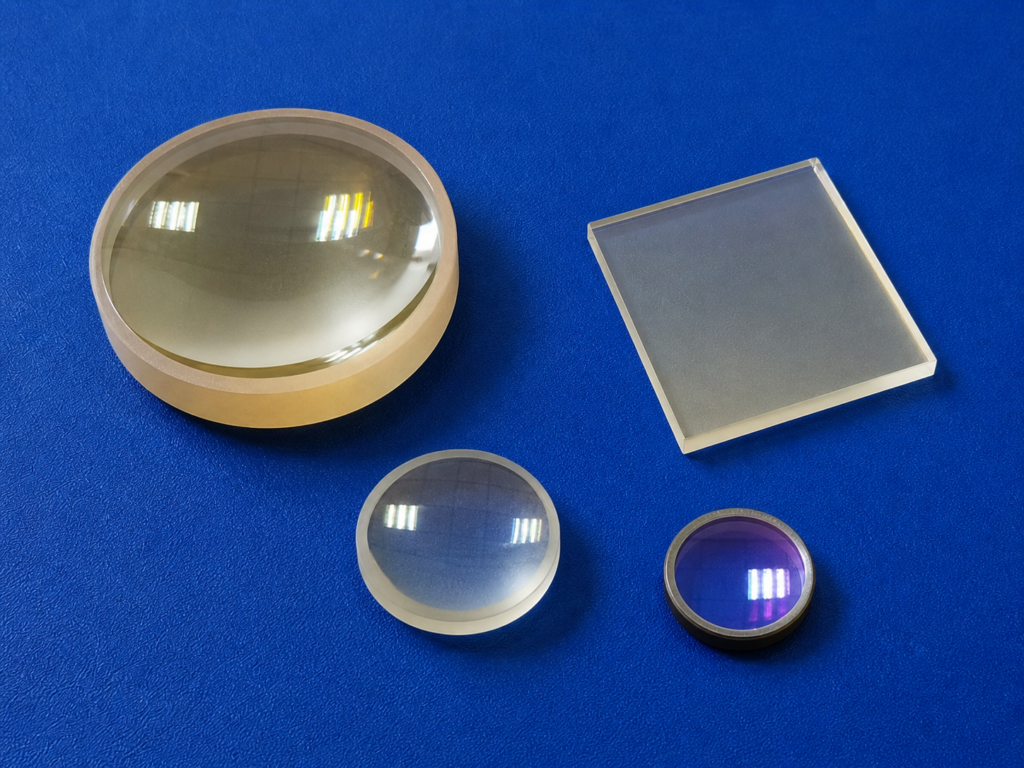
Barium Fluoride (BaF₂) is a crystalline optical material used for applications that require broad wavelength transmission from the ultraviolet region to the mid-infrared region. It is commonly selected for optical windows, lenses, spectroscopy components, and infrared optical systems where wide spectral coverage is required.
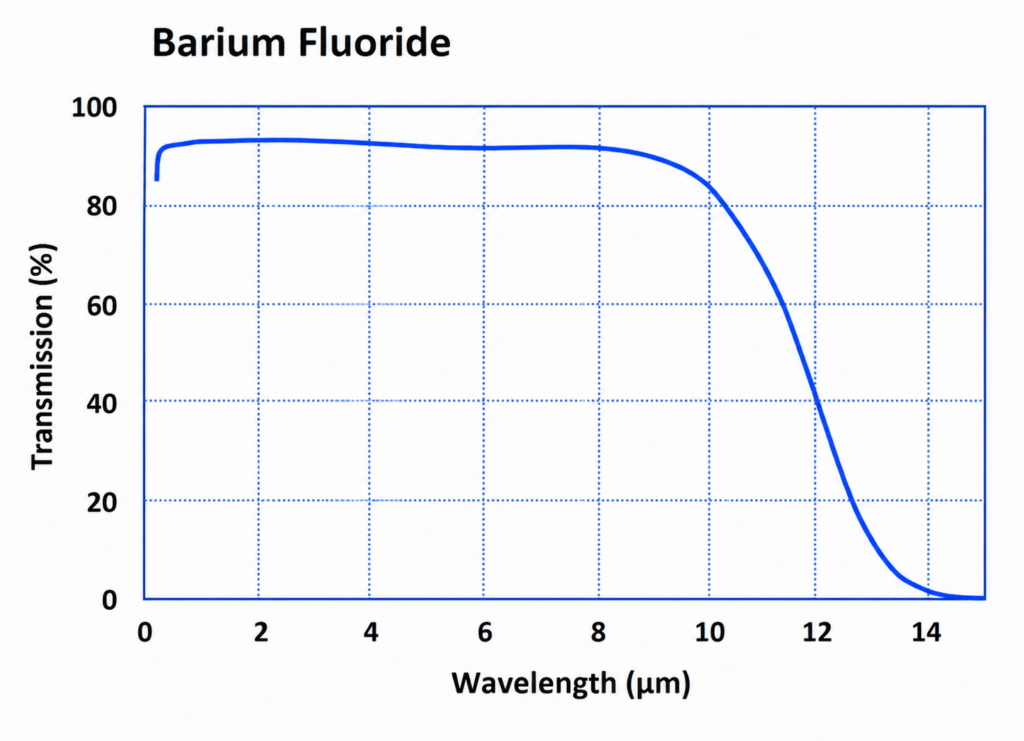
One of the main advantages of BaF₂ is its transmission range. The material can transmit light from approximately 0.20 µm to 11 µm, covering the UV, visible, near-infrared, and mid-infrared regions. Because of this wide transmission band, BaF₂ is useful in optical systems that need to operate across multiple wavelength regions rather than only in the visible or near-infrared range.
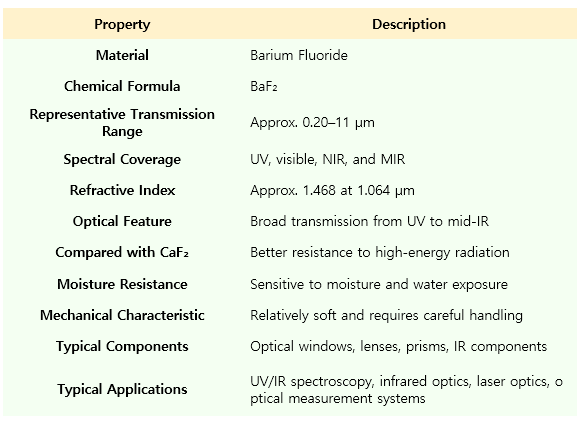
BaF₂ is often compared with Calcium Fluoride (CaF₂) because both materials offer broad optical transmission and low refractive index characteristics. However, BaF₂ has better resistance to high-energy radiation, which can make it useful in systems where radiation exposure is a concern. This property is one reason why BaF₂ may be considered for demanding optical and scientific applications.
In infrared optical systems, BaF₂ can be used as a window or lens material when transmission into the mid-infrared region is required. It is suitable for broadband IR measurement, spectroscopy, laser diagnostics, and optical instruments that need stable transmission beyond the visible wavelength range.
However, BaF₂ also has important handling limitations. It is more sensitive to moisture than some other optical materials and can degrade when exposed to water, especially at elevated temperatures. Therefore, BaF₂ components should be handled carefully, stored in a dry environment, and protected from unnecessary contact with moisture.
BaF₂ is also a relatively soft crystal compared with common optical glasses and harder materials such as sapphire or fused silica. During cleaning, mounting, and assembly, care should be taken to avoid scratches, surface damage, or mechanical stress. Proper coating design, edge protection, and packaging are important for maintaining optical performance.
For practical optical design, BaF₂ is most suitable when broad wavelength transmission is more important than mechanical hardness or moisture resistance. When the operating environment includes humidity, water exposure, high temperature, or mechanical stress, the use of BaF₂ should be reviewed carefully together with coating specifications and system sealing design.
Overall, Barium Fluoride is a valuable optical substrate for UV-to-mid-infrared applications. Its wide transmission range, radiation resistance, and usefulness in spectroscopy and infrared optical systems make it an important material for advanced optical components.
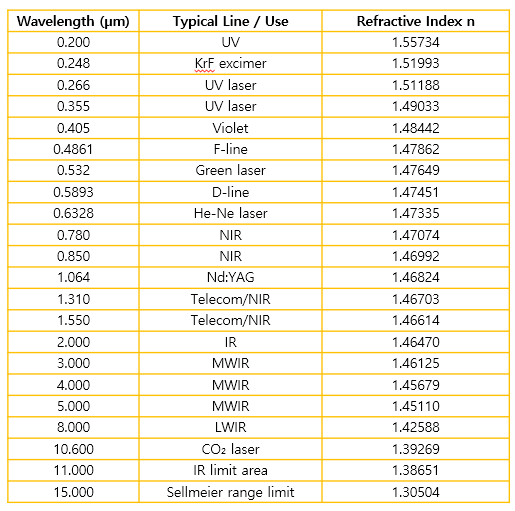
Calculated Refractive Index of BaF₂ Based on the Sellmeier Equation
The refractive index values in the table were calculated using the Sellmeier dispersion equation for Barium Fluoride (BaF₂). The calculation is based on the following wavelength-dependent refractive index equation:
n² − 1 = 0.33973 + (0.81070λ² / (λ² − 0.10065²)) + (0.19652λ² / (λ² − 29.87²)) + (4.52469λ² / (λ² − 53.82²))
where:
λ is the wavelength in micrometers (µm)
n is the refractive index of Barium Fluoride at that wavelength
This equation describes how the refractive index of BaF₂ changes with wavelength. Using this formula, the refractive index was calculated at representative UV, visible, near-infrared, mid-infrared, and CO₂ laser wavelengths. For practical optical design, the most relevant wavelength range for BaF₂ is approximately 0.20–11 µm, which corresponds to its commonly used transmission range. The calculated values help estimate dispersion behavior and are useful for lens design, optical window design, spectroscopy systems, and infrared optical applications.