
Selecting the right optical material is an important step in designing lenses, windows, filters, mirrors, and other precision optical components. Each material has a different transmission range, and the proper choice depends on the operating wavelength, application environment, coating requirement, and mechanical durability.
The table below summarizes representative transmission wavelength ranges for commonly used optical materials.
Note: The values below are general reference ranges. Actual transmission depends on material grade, thickness, surface quality, coating design, purity, crystal quality, and measurement conditions.
| Optical Material | Representative Transmission Range | Main Applications / Notes |
|---|---|---|
| MgF₂ | 0.12–7.0 µm | VUV/UV optics, excimer laser optics, UV windows |
| UV Fused Silica | approx. 0.18–2.1 µm | UV–VIS–NIR optics, precision lenses, laser optics |
| N-BK7 / BK7 | approx. 0.35–2.0 µm | General visible and near-infrared optics, lenses, windows |
| Sapphire (Al₂O₃) | approx. 0.17–5.5 µm | Durable optical windows, UV to mid-IR applications, harsh environments |
| Calcium Fluoride (CaF₂) | approx. 0.18–8.0 µm | UV and IR optics, low-dispersion optics, spectroscopy |
| Barium Fluoride (BaF₂) | approx. 0.20–11.0 µm | UV to LWIR optics, spectroscopy, infrared windows |
| Silicon (Si) | approx. 1.2–7.0 µm | MWIR optics, infrared filters, optical substrates |
| Germanium (Ge) | approx. 2.0–14.0 µm | Thermal imaging optics, LWIR lenses and windows |
| Zinc Sulfide (ZnS / Cleartran) | approx. 0.4–12.0 µm | Multispectral infrared windows, IR optical systems |
| Zinc Selenide (ZnSe) | approx. 0.6–16.0 µm | CO₂ laser optics, IR windows, IR lenses, ATR prisms |
Why Transmission Range Matters
Transmission range shows the wavelength region where an optical material can efficiently transmit light. If the material does not transmit well at the required wavelength, the optical system may suffer from high absorption, low signal quality, thermal loading, or reduced efficiency.
For example, UV systems often require materials such as MgF₂, UV fused silica, or CaF₂. Visible and near-infrared systems commonly use BK7 or fused silica. Infrared and thermal imaging systems often require materials such as silicon, germanium, ZnS, or ZnSe.
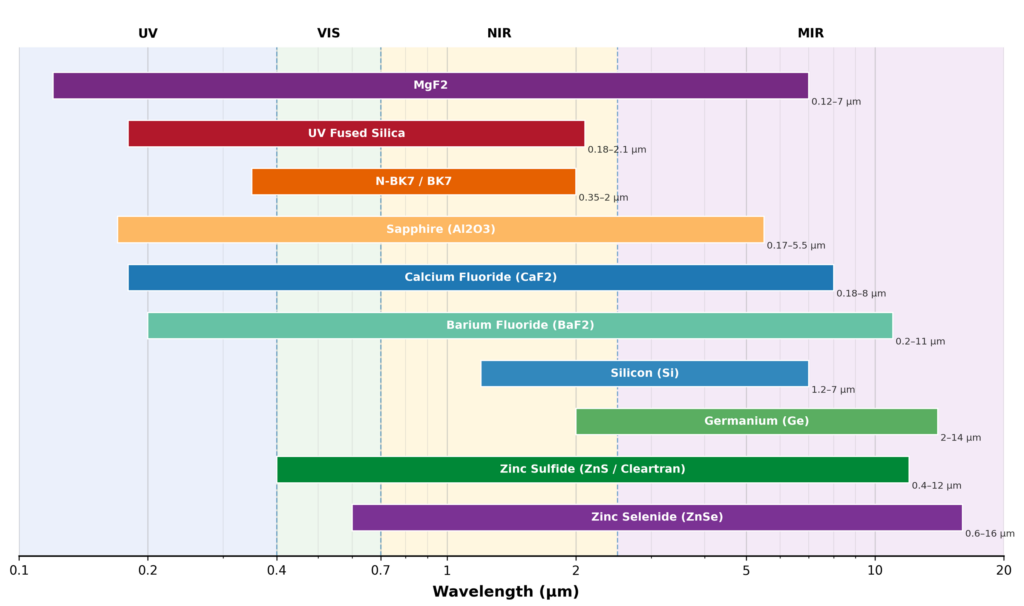
The following figure illustrates the representative wavelength transmission ranges of various optical materials.
Important Selection Factors
When selecting an optical material, the transmission range should not be reviewed alone. The following factors should also be considered:
- Operating wavelength
- Material thickness
- Surface quality
- Coating requirement
- Reflection loss
- Thermal stability
- Mechanical strength
- Environmental durability
- Laser power or energy density
- Cost and availability
In many cases, optical coating is required to improve transmission, reduce reflection, increase durability, or optimize performance at a specific wavelength.
Practical Examples
For UV optics, MgF₂ and UV fused silica are commonly used because of their strong transmission in the ultraviolet region.
For visible and NIR optics, BK7 and fused silica are widely used because they offer good optical performance and manufacturability.
For MWIR and LWIR applications, silicon and germanium are commonly selected depending on the wavelength range and system requirements.
For CO₂ laser optics, ZnSe is one of the most widely used materials because it provides strong transmission around 10.6 µm.
Conclusion
Choosing the right optical material is essential for achieving stable optical performance. The best material depends on the required wavelength range, optical design, coating, mechanical durability, and operating environment.
General Optics supports custom optical components for UV, visible, near-infrared, mid-infrared, and long-wave infrared applications. Our capabilities include optical fabrication, coating, inspection, and application-based material review.
Need help selecting the right optical material for your application? Contact General Optics to discuss your custom optical component requirements.