
Content
Selecting the right custom optical component is an important step in building a reliable optical system. In many industrial, scientific, laser, imaging, infrared, and defense-related applications, standard optical components may not fully meet the required performance, durability, or integration conditions.
A custom optical component can be designed and manufactured according to the required wavelength range, material, coating, dimensional tolerance, surface quality, and operating environment.
This article explains the key factors to consider before selecting or requesting a custom optical component.
1. Define the Application First
The first step is to clearly define where and how the optical component will be used.
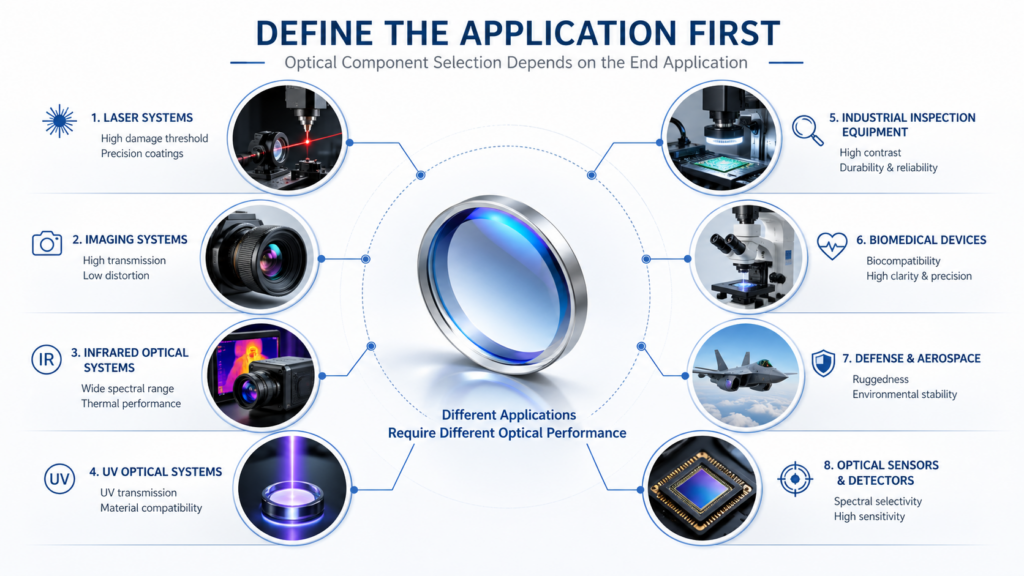
Different applications require different optical performance:
- Laser systems
- Imaging systems
- Infrared optical systems
- UV optical systems
- Industrial inspection equipment
- Biomedical devices
- Defense and aerospace systems
- Optical sensors and detectors
For example, an optical window used in a high-power laser system may require high laser damage resistance, while an IR window used in thermal imaging may require high transmission in the MWIR or LWIR wavelength range.
Before selecting a component, it is important to define the optical function, operating wavelength, power level, and environmental conditions.
2. Confirm the Wavelength Range
Wavelength is one of the most important factors in optical component selection.
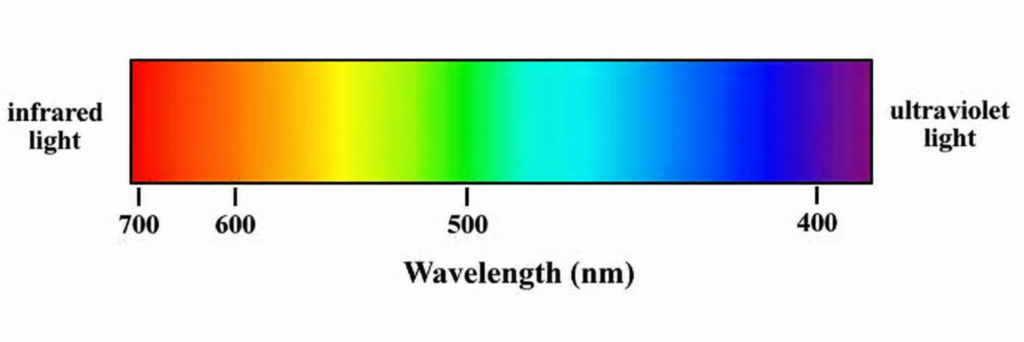
The proper material and coating depend strongly on the operating wavelength range. A material that performs well in the visible range may not be suitable for ultraviolet or infrared applications.
Common wavelength ranges include:
- UV: ultraviolet applications
- VIS: visible light applications
- NIR: near-infrared applications
- SWIR: short-wave infrared applications
- MWIR: mid-wave infrared applications
- LWIR: long-wave infrared applications
For UV applications, materials such as fused silica or CaF2 may be considered. For infrared applications, materials such as silicon, germanium, ZnSe, CaF2, or sapphire may be required depending on the wavelength and application.
Correct wavelength selection helps ensure high transmission, low loss, and stable optical performance.
3. Select the Proper Optical Material
Material selection directly affects transmission, durability, thermal stability, and manufacturing feasibility.
Common optical materials include:
- Optical glass
- Fused silica
- Sapphire
- Silicon
- Germanium
- ZnSe
- CaF2
- MgF2
- BK7
- Quartz
Each material has different optical, mechanical, and thermal characteristics.
For example, fused silica is widely used for UV and high-precision optical applications because of its excellent transmission and thermal stability. Germanium is commonly used for infrared optics, especially in thermal imaging applications. Sapphire is often selected when high mechanical strength and environmental durability are required.
When choosing a material, the following points should be reviewed:
- Transmission range
- Thermal expansion
- Mechanical strength
- Chemical resistance
- Coating compatibility
- Cost and availability
- Machining difficulty
Material selection should be reviewed together with the final optical design and application environment.
4. Determine the Required Optical Specification
A custom optical component should be defined with clear specifications.
Important optical and mechanical specifications may include:
- Diameter
- Thickness
- Clear aperture
- Radius of curvature
- Surface accuracy
- Surface quality
- Parallelism
- Wedge angle
- Flatness
- Chamfer
- Edge thickness
- Center thickness
- Dimensional tolerance
For high-performance optical systems, small dimensional errors can affect alignment, beam quality, imaging performance, or transmission efficiency.
Surface quality is also important. Scratch-dig quality, surface roughness, and coating uniformity should be selected according to the application.
For precision laser, imaging, and infrared systems, it is recommended to define both optical performance requirements and mechanical tolerance requirements at the early design stage.
5. Choose the Right Optical Coating
Optical coating is one of the most critical factors in custom optics.
Coatings can improve transmission, control reflection, increase durability, or define a specific spectral function.
Common coating types include:
- Anti-reflection coating
- High-reflection coating
- Bandpass filter coating
- Longpass filter coating
- Shortpass filter coating
- Polarizing coating
- DLC coating
- Metal coating
- IR coating
- UV coating
Anti-reflection coating is used to reduce unwanted reflection and improve transmission. High-reflection coating is used for mirrors and laser systems. Filter coatings are used to transmit or block specific wavelength ranges.
For harsh environments, DLC coating may be considered because it provides improved durability, scratch resistance, and environmental stability.
When specifying a coating, the following information is useful:
- Operating wavelength range
- Incident angle
- Required transmission or reflection
- Polarization condition
- Laser power or energy density
- Environmental exposure
- Substrate material
- Required durability standard
A well-designed coating can significantly improve the performance and reliability of the optical system.
6. Review Environmental Conditions
Optical components are often used in demanding environments.
Before finalizing the specification, the operating environment should be reviewed carefully.
Important environmental factors include:
- Temperature
- Humidity
- Thermal shock
- Salt spray
- Dust and contamination
- Vibration
- Laser exposure
- Outdoor use
- Vacuum condition
- Chemical exposure
For industrial, defense, aerospace, and outdoor optical systems, environmental durability can be as important as optical performance.
If the component will be used in harsh conditions, additional durability testing or environmental verification may be required.
Examples include:
- Temperature cycling test
- Humidity test
- Adhesion test
- Abrasion test
- Salt spray test
- Laser damage threshold test
These tests help confirm whether the optical component can maintain stable performance under real operating conditions.
7. Consider Manufacturing and Inspection Capability
A custom optical component is not only a design item. It must also be manufacturable and measurable.
Before placing an order, it is important to confirm whether the supplier can support the full process:
- Material sourcing
- Cutting
- Grinding
- Polishing
- Centering
- Coating
- Assembly
- Inspection
- Packaging
Inspection capability is especially important for precision optics.
Typical inspection items include:
- Dimensional measurement
- Surface quality inspection
- Flatness measurement
- Radius measurement
- Transmission measurement
- Reflection measurement
- Coating spectral measurement
- Environmental test report
- Laser damage test report
A supplier with in-house manufacturing and inspection capability can reduce communication errors, shorten lead time, and provide better quality control.
8. Prepare Clear RFQ Information
To receive an accurate quotation, the customer should prepare clear technical information.
A good RFQ for custom optical components should include:
- Drawing or 3D file
- Material
- Diameter and thickness
- Tolerance
- Wavelength range
- Coating requirement
- Quantity
- Application
- Required test data
- Target delivery schedule
- Packaging requirement
If the full specification is not fixed yet, it is also possible to start with application information and required optical performance.
For example:
“Our system uses a 10.6 μm CO2 laser and requires a coated ZnSe window with high transmission and high durability.”
This type of information helps the supplier recommend suitable material, coating, and test conditions.
9. Work with a Technical Partner, Not Only a Supplier
For custom optical components, it is better to work with a technical partner rather than only a parts supplier.
A technical partner can support:
- Specification review
- Material recommendation
- Coating design discussion
- Manufacturability review
- Prototype production
- Inspection planning
- Long-term supply support
This is especially important for OEM customers, R&D projects, and systems that require stable optical performance over time.
The right partner can help reduce development risk and improve the final system performance.
Conclusion
Choosing the right custom optical component requires careful review of wavelength, material, optical specification, coating, tolerance, environmental conditions, and inspection requirements.
A well-defined custom optical component can improve transmission, reduce optical loss, increase durability, and support stable performance in demanding applications.
General Optics supports custom optical components through optical fabrication, coating, inspection, and technical consultation. We provide solutions for UV, visible, infrared, laser, imaging, and industrial optical applications.
If you need a custom optical component for your project, contact General Optics to discuss your optical requirements.